Star Ocean Till The End Of Time Strategy Guide Pdf Download
| Star Body of water: Till the End of Fourth dimension | |
|---|---|
 | |
| Programmer(south) | tri-Ace |
| Publisher(s) | Enix Square Enix (Managing director's Cut) |
| Director(s) | Yoshiharu Gotanda |
| Producer(s) | Yoshinori Yamagishi Hajime Kojima |
| Designer(s) | Masaki Norimoto |
| Artist(due south) | Jun Sato Keiichi Asai |
| Writer(due south) | Yoshiharu Gotanda Hiroshi Ogawa |
| Composer(s) | Motoi Sakuraba |
| Series | Star Ocean |
| Platform(due south) | PlayStation 2 |
| Release | Original Version
|
| Genre(southward) | Activity office-playing |
| Mode(s) | Unmarried-player, multiplayer (Managing director'due south Cut simply) |
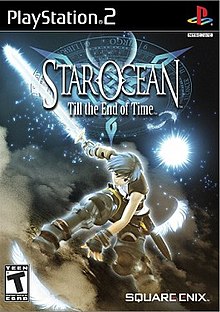
Star Bounding main: Till the Finish of Time [a] is an activity function-playing game, the tertiary main game in the Star Ocean series. The game was adult by tri-Ace and published by Square Enix for the PlayStation 2 console. Information technology was released in Japan, North America, and the PAL territories. The original Japanese release appointment was in Feb 2003 by Enix, its penultimate release earlier its merger to become Foursquare Enix. It was re-released in 2004 as a two-disc Manager'southward Cut version with bonus features such as new characters and dungeons. The Northward American and European versions are based on the Manager's Cutting version.[i] [2] Till the Terminate of Fourth dimension takes identify iv hundred years after the events of Star Body of water: The 2d Story.
Gameplay [edit]
While having many similarities to its predecessor, Star Ocean: Till the End of Fourth dimension includes many elements that go far unique among the majority of role-playing video games. Instead of menu-driven combat, Star Ocean iii offers real-time interactive combat, like to the .hack and Tales series. Battles occur when running into enemies on the main travel field or when certain pre-scripted events occur. In boxing, the player directly controls one graphic symbol, while the other 2 characters are controlled past AI. The player can, however, choose the tactics used past AI characters or switch which character they are directly decision-making.

Fayt (left), Nel (heart), and Adray (right) fighting an enemy in a boxing
Enemy attacks tin can target either a histrion's hit points (HP) or mental points (MP). Players will also lose HP from using special attacks or lose MP from using symbology or runeology, which is functionally equivalent to magic in other games.[3] If a character loses all of their HP or, different most games, if they lose all of their MP, they are knocked out and unable to continue participation in the boxing (unless certain revival items are used). Each grapheme also has a Fury meter, which governs how fast the character moves over the battle screen, and how often actions can be performed. Standing still will replenish Fury, while whatever movement will continue to drain it or cause the character to lag. If all three characters are defeated, the game is over and the player must reload from their last saved game. If all the enemies are defeated, the player is awarded money (Fol) and experience points (EXP). When some groups of enemies are defeated, the player's characters tin can also receive a small-scale corporeality of HP/MP, to counteract the HP/MP that was lost as a result of using special attacks or symbology/runeology.
When the role player strikes an enemy, the Bonus Battle Gauge will make full. When the gauge reaches full capacity, the role player will enter "Bonus Battle". In "Bonus Battle", the player receives special bonuses, which can help benefit a grapheme's EXP, Fol, items received subsequently battle, etc. Nevertheless, if a character receives a critical hit, runs abroad from boxing, or dies, the judge will deplete completely, resulting in the end of "Bonus Battle" and any bonuses the actor received. The Bonus Battle Gauge will too reset if the histrion turns the game off and turns it dorsum on, or restarts their save file.
Similar the previous games in the series, the game contains an Item Creation feature that allows the player to create and raise a multitude of items. A multifariousness of trades are offered, including Cookery, Alchemy, Engineering, and Smithery. Workshops for Item Creation are scattered throughout the towns and dungeons of the game and can be invested in by the histrion to allow a wider variety of items to be made there. In one case a histrion invents an item, they tin can file for a patent, and get money from the profits made off selling those items in diverse shops. The player is also able to recruit inventors to aid them in creating various items.
The Director'southward Cut version added a VS. Mode to battle against a 2nd role player or against the reckoner. Up to two human players could compete, either confronting each other or against another grapheme controlled past the computer. Some other improver was the apply of "Boxing Trophies" which may be acquired by completing various challenges in combat. For example, a role player can receive a battle trophy for winning a battle in nether 30 seconds, or for defeating a boss without receiving damage. Earning battle trophies unlocks bonus options such as harder game difficulty levels, alternate costumes, and a sound test.
Story [edit]
Setting [edit]
The universe of Star Ocean is science fiction in nature, although similar the first two games in the series, much of the plot is assail an "underdeveloped planet." The game is prepare in South.D 772 (A.D 2858). It features a milky way-spanning government in the Pangalactic Federation, several races and species of aliens, unlike factions, multiple colonized planets, and avant-garde technology. Merely despite this science fiction atmosphere, a course of magic exists in the universe: symbology, also translated as heraldry in the Japanese version and in Star Ocean: The Second Story. Standard symbology involves tattooing crests and runes onto one's mankind to depict out apparently latent power in the form of spells, and numerous underdeveloped planets make extensive use of it. Despite its supernatural connotations, Symbology is treated as a legitimate field of scientific study in-universe.
Plot [edit]
Star Bounding main: Till the End of Time begins on the planet Hyda Iv where a boyfriend, Fayt Leingod, and his childhood friend, Sophia Esteed, are on vacation with Fayt's family. Fayt is the son of Robert Leingod, a famous scientist in the field of symbological genetics. For an unknown reason, the Vendeeni — an alien civilization with highly advanced technology that spans only a single planet — attacks Hyda Four unprovoked, thus initiating a war with the Pangalactic Federation. Fayt and Sophia escape on the starship Helre, only are separated from Fayt'south parents, Robert and Ryoko Leingod. The Helre is also attacked by the Vendeeni, and the two are separated.
Fayt'southward escape pod lands on the "underdeveloped planet" Vanguard III, a planet with technology equivalent to 16th Century World, and discovers an off-world criminal, the exiled Rezerbian Norton, plotting to take it over. Cliff Fittir, a member of the anti-Federation organisation Quark, and so lands and helps Fayt defeat this criminal. Fayt learns that Quark's leader wishes to speak to him and plans on rescuing his father, though Cliff does not reveal the reason behind this interest. After getting off the planet with Cliff and meeting his assistant Mirage, the Vendeeni over again attack them — simply they escape and bump on another underdeveloped world, Elicoor Two. Elicoor seems to be around 17th Century Earth in terms of technological advancement. Fayt, Cliff, and Mirage crash-land into the capital letter of the Kingdom of Airyglyph, who believe that their transport is a weapon adult by the country they are at war with, Aquaria. Fayt and Cliff are imprisoned every bit a event Mirage escapes, though they are soon rescued by an assassin-similar agent, Nel Zelpher, who believes they are engineers from the technologically advanced continent of Greeton. She rescues them under the condition that they aid her land, Aquaria, with their technological noesis or that she volition kill them to prevent them leaking secrets to Airyglyph. This leads the two directly into the war betwixt the two kingdoms and eventually into a great last battle between them. Then a new — at to the lowest degree to the Elicoorians — foe appears in the skies above, a Vendeeni battleship that has plant their quarry. However, Fayt destroys the battleship with a previously unknown power of his, though another battleship remains in orbit. During the distraction, the leader of Quark, Maria Traydor, manages to arrive on Elicoor. It seems that both Quark and the Vendeeni knew of Fayt'south unusual abilities, and he had been their target the whole time. The party vies with the Vendeeni over control of an unusual "out of identify antiquity" and Fayt'due south begetter, who is killed before Maria can end interrogating him over his "crimes."
Fayt finds himself space-borne once more, and the galaxy has not stood however. Shortly after the apparently unprovoked assault on Hyda IV, a threat of destruct-full magnitude emerges in the class of ultra-powerful space-borne beings calling themselves "Executioners." The best ships of the Federation and the Vendeeni are nearly powerless against these new beings, and are quickly being forced into full retreat. The party, acting on a hint from Fayt's male parent, venture to the Moonbase inquiry station, and Fayt is reunited with Sophia. While on the station, they are confronted by an celestial-looking Executioner that calls itself Proclaimer. It launches itself to assault, telling them that they must be destroyed.
Investigation of the Moonbase records reveals the truth behind the Executioners and their appearance. During the charting of a planet chosen Styx, explorers encountered an extremely avant-garde and extremely former Time Gate. When activated, it informed them that their forays into the field of symbological genetics had angered the Creator, and that they were to be destroyed. Even if they were to carelessness symbological genetics, the reins would exist taken up by another before long enough, and that they were not being warned — they were existence sentenced.
The explorers beat a hasty retreat and informed the Federation of what they had plant. Studies shortly suggested that the statement came from another airplane of existence; an entirely new universe. Farther study revealed that symbology might be used to admission this universe. The scientists agreed to apply their ain offspring; the subjects were Fayt Leingod, Sophia Esteed, and Maria Traydor. Fayt was the son of Robert and Ryoko Leingod, while Sophia was the daughter of Clive Esteed. Maria was an orphan who was after adopted by the fourth member of the team, Jessie Traydor. The iii were symbologically altered in such a way that if they worked together, they could gain entry through the Fourth dimension Gate. Maria was given the ability of Alteration, which would allow her and those with her to remain in physical forms in the new globe. Fayt was given the power of Destruction, as information technology was assumed they would need to physically defend themselves. Two years later, the younger Sophia was given the power of Connection - the key ability needed to make contact with 4D space. The Vendeeni had been attacking in hopes of handing over Fayt to the Executioners and staying their wrath.
The party goes to Styx and finds the expanse flooded with Executioners. Escaping their ship in a small-scale shuttle, they witness the mysterious beings and their awesome might first-hand as the Federation battleship Aquaelie which had escorted them is destroyed. Reaching the Time Gate, the party enters "4D space," a dimension higher than their ain. According to the 4D beings, their universe is actually not real in relation to 4D space; rather, it is a computer simulation developed by Luther Lansfeld, the possessor of the Sphere Company. Dubbed the "Eternal Sphere", it is like to a real-world massively multiplayer online game for the inhabitants of 4D space.
Fayt and his allies learn that the Executioners are anti-viruses sent to delete anomalies in the Galaxy section of the Eternal Sphere. With the help of Blair Lansfeld, programmer and sister to Luther, the political party manages to detect Luther. Blair and the group believe that the residents of the Eternal Sphere have managed to achieve a level of intelligence equal to that of 4D citizens; Luther, nevertheless, considers them "mere information." Luther then decides that the just way to delete them is to delete the entire universe (apparently ignoring that he is currently in the Eternal Sphere). The political party fights and defeats him, causing him to be deleted himself, merely fails to stop the deletion.
All the same, the universe is not destroyed for non entirely articulate reasons. Blair mentions an "Eternal Sphere backup" earlier, merely there's no evidence that it was practical. The characters decide that fifty-fifty if they actually are just programs, they have achieved "consciousness" and therefore cannot be deleted. Alternatively, others suggest Maria'south power of Alteration has something to practice with it, mayhap fifty-fifty implying that their universe has truly become a reality unto itself and therefore not subject to deletion.
The catastrophe slightly changes based on the "affection level" of the other characters for Fayt, derived from the histrion'south choices during the game and in Private Actions. Fayt has an ending for each character if that character has the highest amore level with him, also equally an "alone" ending if no one has sufficient affection level with him.
Evolution [edit]
One of the major influences of the design changes from Star Body of water: The 2nd Story to Till the End of Time was Star Trek.[iv] The gainsay arrangement was more often than not unaltered from the previous title, only characters were rendered in 3D instead of second and more strategy was incorporated into the fights.[4] Transitioning to a completely 3D environment from a 2d/3D mix was a lengthy process, and was only possible due to the increased power of the PlayStation 2 panel.[4] In terms of story message, game producer Yoshinori Yamagishi stated that the main message the game communicates is ane of "trust".[iv] Several characters and dungeons did not brand the cutting for the final version of the game, but most of what developers wanted plant its way into the game.[4] Gameplay balance was adjusted between the Japanese and American releases, as well equally fixing various technical errors that occurred in the original Japanese release.[4]
Soundtrack [edit]
The music for this game was equanimous past Motoi Sakuraba, a long-fourth dimension collaborator with tri-Ace. The soundtrack was eventually released in four parts:
- Original Soundtrack Volume 1 - A 2-CD gear up containing mainly the softer and orchestral pieces from the game.
- Original Soundtrack Volume 2 - Another two-CD ready containing the upbeat music, primarily the battle and dungeon themes.
- Arrange Album - A pick of tracks from the game reworked in different styles.
- Voice Mix - Similar to the Arrange Album, but featuring dialogue sampled from the Japanese version of the game forth with the music.
The express edition of Volume 1 likewise came with a box to hold all four albums.
When the game was revised into the Managing director's Cutting, Sakuraba composed a few new pieces of music and released an album for them.
The song "The Small Bird That Forgot How To Fly" (飛び方を忘れた小さな鳥, Tobikata Wo Wasureta Chiisana Tori) past the JPop vocalist Misia was used to back-trail the game'south catastrophe credits.
Reception [edit]
Initially, the game received a somewhat negative impression in Japan. Parts of the game were alleged to be buggy, and the game refused to piece of work at all in older SCPH-10000 PlayStation 2s. Enix blamed Sony, equally they had coded Star Ocean 3 with features from updated libraries that were obviously non backward-compatible.[11] Sony denied all responsibility. Regardless, it impacted the game'southward sales, and Enix released the Manager'southward Cut in 2004 to assuage grievances about the original by fixing the bugs and adding features. In Northward America, the game was initially well received amongst both critics and players, with GameRankings, a compilation of critical reviews, giving information technology an average score of fourscore.99%. Star Bounding main iii was the 96th-best seller among console games of the PS2/GameCube/Xbox generation as of July 2006; it had estimated U.S. sales of 630,000 copies, with revenues of $23 million.[12] In Japan, the original release sold 533,373 in 2003,[13] [14] while the Director'due south Cut sold 207,881 copies between 2004 and 2009,[15] bringing worldwide sales to i,371,254 units. IGN placed Till the Stop of Fourth dimension at number 58 on their "Top 100 PlayStation 2 Games" list.[16]
Notes [edit]
- ^ Known in Japan equally Star Ocean 3 ( スターオーシャン3 , Sutā Ōshan Surī )
References [edit]
- ^ Fahey, Rob (May 5, 2004). "Ubisoft to publish Square Enix' Star Ocean iii in Europe". GamesIndustry International. Retrieved May 26, 2012.
- ^ a b Bethany Massimilla (August thirty, 2004). "Star Body of water: Till the End of Fourth dimension Review". GameSpot. Archived from the original on 2012-04-22. Retrieved May 26, 2012.
- ^ Symbology (Heraldry in Japanese) and runeology are equivalent terms for the same concept in-game. The aforementioned concept was chosen "Heraldry" in Star Ocean: The Second Story.
- ^ a b c d e f IGN Staff (2003-05-16). "E3 2003: Star Ocean: Till the End of Time Interview". IGN. Retrieved 2016-04-03 .
- ^ "Star Body of water: Till the Cease of Time for PlayStation ii". GameRankings. CBS Interactive. Retrieved May 26, 2012.
- ^ "Star Ocean: Till the End of Time for PlayStation two Reviews". Metacritic. CBS Interactive. Retrieved July 26, 2018.
- ^ "Star Ocean 3: Till the End of Time for PlayStation four Reviews". Metacritic. CBS Interactive. Retrieved July 26, 2018.
- ^ "スターオーシャン Till the Cease of Fourth dimension [PS2]" [Star Ocean Till the Terminate of Time [PS2]] (in Japanese). Famitsu. Retrieved September 4, 2015.
- ^ "Star Ocean: Till the End of Time review". Game Informer. Archived from the original on October 11, 2007.
- ^ Jeremy Dunham (August half dozen, 2004). "Star Bounding main: Till the End of Time - PlayStation 2 Review". IGN. Retrieved May 26, 2012.
- ^ Putnam, Gabriel (March 8, 2003). "Enix Lays Star Bounding main iii Failures at Sony's Anxiety". RPGamer.com. Archived from the original on December 28, 2008. Retrieved January 2, 2009.
- ^ Border Staff (July 29, 2006). "The Top 100 Games of the 21st Century". Border-Online.com. Archived from the original on 2012-05-23. Retrieved 2009-01-02 .
- ^ "Sony PS2 Japanese Ranking". Japan-GameCharts.com. Archived from the original on December 16, 2008. Retrieved 2009-01-02 .
- ^ "2003年ゲームソフト年間売上TOP300" [2003 Game Software Annual Sales Height 300]. Famitsū Gēmu Hakusho 2004 ファミ通ゲーム白書2004 [Famitsu Game Whitebook 2004] (in Japanese). Tokyo: Enterbrain. 2004. Archived from the original on 2014-10-09.
- ^ "Star Ocean 3 Till the End of Time Director'southward Cut". Japan Game Sales Database. 2009. Retrieved October 14, 2018.
- ^ "#58: Star Sea: Till the End of Time". IGN. Retrieved April 4, 2016.
External links [edit]
- Official website (in Japanese)
- Official website (in Japanese) (Director's Cut)
- Star Ocean: Till the End of Time at GameFAQs
- Star Ocean: Till the Finish of Time at MobyGames
DOWNLOAD HERE
Posted by: jamessquithrilve.blogspot.com
Post a Comment