Mastering The Requirements Process Pdf Free Download
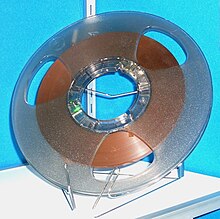
Mastering, a form of audio mail service production, is the process of preparing and transferring recorded audio from a source containing the terminal mix to a data storage device (the master), the source from which all copies will be produced (via methods such as pressing, duplication or replication). In recent years digital masters have become usual, although analog masters—such as audio tapes—are still being used past the manufacturing manufacture, particularly by a few engineers who specialize in analog mastering.[ commendation needed ]
Mastering requires disquisitional listening; all the same, software tools be to facilitate the process. Results depend upon the intent of the engineer, the skills of the engineer, the accuracy of the speaker monitors, and the listening environment. Mastering engineers often apply equalization and dynamic range compression in order to optimize sound translation on all playback systems.[i] It is standard practice to make a copy of a master recording—known as a safety copy—in case the primary is lost, damaged or stolen.
History [edit]
Pre-1940s [edit]
In the earliest days of the recording industry, all phases of the recording and mastering procedure were entirely accomplished past mechanical processes. Performers sang and/or played into a large audio-visual horn and the main recording was created by the direct transfer of acoustic energy from the diaphragm of the recording horn to the mastering lathe, typically located in an adjoining room. The cutting head, driven by the energy transferred from the horn, inscribed a modulated groove into the surface of a rotating cylinder or disc.[2] These masters were commonly made from either a soft metal alloy or from wax; this gave rise to the colloquial term waxing, referring to the cutting of a record.[3]
After the introduction of the microphone and electronic amplifier in the mid-1920s, the mastering process became electro-mechanical, and electrically driven mastering lathes came into use for cutting master discs (the cylinder format past then having been superseded). Until the introduction of tape recording, master recordings were well-nigh always cut direct-to-disc.[2] Only a minor minority of recordings were mastered using previously recorded material sourced from other discs.
Emergence of magnetic tape [edit]
In the tardily 1940s, the recording industry was revolutionized by the introduction of magnetic record. Magnetic record was invented for recording sound by Fritz Pfleumer in 1928 in Deutschland, based on the invention of magnetic wire recording by Valdemar Poulsen in 1898. Not until the stop of Earth War II could the technology be establish outside Europe. The introduction of magnetic tape recording enabled master discs to exist cut separately in fourth dimension and space from the actual recording process.[ii]
Although record and other technical advances dramatically improved the audio quality of commercial recordings in the post-war years, the basic constraints of the electro-mechanical mastering process remained, and the inherent physical limitations of the main commercial recording media—the 78 rpm disc and subsequently the vii-inch 45 rpm single and 33-1/three rpm LP record—meant that the sound quality, dynamic range,[a] and running time[b] of primary discs were still express compared to later on media such equally the compact disc.
Electro-mechanical mastering procedure [edit]
From the 1950s until the appearance of digital recording in the tardily 1970s, the mastering procedure typically went through several stages. Once the studio recording on multi-track tape was complete, a final mix was prepared and dubbed down to the master tape, usually either a single-track mono or two-rails stereo tape. Prior to the cutting of the principal disc, the master tape was oft subjected to further electronic treatment by a specialist mastering engineer.
Later the advent of tape information technology was found that, especially for pop recordings, chief recordings could be fabricated so that the resulting record would sound amend. This was done past making fine adjustments to the amplitude of sound at unlike frequency bands (equalization) prior to the cutting of the master disc.
In large recording companies such every bit EMI, the mastering process was usually controlled by specialist staff technicians who were conservative in their work practices. These big companies were often reluctant to brand changes to their recording and product processes. For example, EMI was very slow in taking up innovations in multi-track recording[c] and did not install 8-track recorders in their Abbey Road Studios until the late 1960s, more a decade after the starting time commercial 8-runway recorders were installed by American independent studios.[four]
Digital technology [edit]

Optimum Digital Levels with respect to the Total Digital Scale (dBFSD)
In the 1990s, electro-mechanical processes were largely superseded by digital applied science, with digital recordings stored on difficult disk drives or digital tape and mastered to CD. The digital audio workstation (DAW) became common in many mastering facilities, allowing the off-line manipulation of recorded sound via a graphical user interface (GUI). Although many digital processing tools are common during mastering, information technology is besides very common to apply analog media and processing equipment for the mastering stage. Just every bit in other areas of sound, the benefits and drawbacks of digital applied science compared to analog technology are still a matter for debate. However, in the field of audio mastering, the debate is normally over the utilise of digital versus analog indicate processing rather than the apply of digital engineering science for storage of audio.[1]
Digital systems take higher performance and allow mixing to be performed at lower maximum levels. When mixing to 24-bits with peaks between -three and -10 dBFS on a mix, the mastering engineer has enough headroom to process and produce a final master.[5] It is important to allow plenty headroom for the mastering engineer's work.[6] Reduction of dynamics by the mix or mastering engineer has resulted in a loudness war in commercial recordings.[7]
Process [edit]

The source material, ideally at the original resolution, is processed using equalization, compression, limiting and other processes. Boosted operations, such as editing, specifying the gaps between tracks, adjusting level, fading in and out, dissonance reduction and other point restoration and enhancement processes tin likewise exist applied as role of the mastering stage.[7] The source material is put in the proper order, commonly referred to equally assembly (or 'track') sequencing. These operations set the music for either digital or analog, e.g. vinyl, replication.
If the material is destined for vinyl release, additional processing, such as dynamic range reduction or frequency-dependent stereo–to–mono fold-down and equalization may exist practical to compensate for the limitations of that medium. For compact disc release, start of runway, stop of rails, and indexes are defined for playback navigation along with International Standard Recording Code (ISRC) and other information necessary to replicate a CD. Vinyl LP and cassettes accept their own pre-duplication requirements for a finished chief. Subsequently, information technology is rendered either to a physical medium, such equally a CD-R or DVD-R, or to estimator files, such as a Disc Description Protocol (DDP) file ready or an ISO image. Regardless of what commitment method is chosen, the replicator manufactory volition transfer the audio to a glass main that will generate metal stampers for replication.
The procedure of audio mastering varies depending on the specific needs of the audio to be processed. Mastering engineers need to examine the types of input media, the expectations of the source producer or recipient, the limitations of the end medium and process the subject accordingly. General rules of thumb can rarely be practical.
Steps of the process typically include the following:
- Transferring the recorded audio tracks into the Digital Audio Workstation (DAW)
- Sequence the separate songs or tracks equally they will appear on the concluding release
- Adjust the length of the silence between songs
- Process or sweeten audio to maximize the sound quality for the intended medium (e.1000. applying specific EQ for vinyl)
- Transfer the audio to the final principal format (CD-ROM, half-inch reel record, PCM 1630 U-matic tape, etc.)
Examples of possible deportment taken during mastering:[seven]
- Editing minor flaws
- Applying noise reduction to eliminate clicks, dropouts, hum and hiss
- Adjusting stereo width
- Equalize audio across tracks for the purpose of optimized frequency distribution
- Suit volume
- Dynamic range pinch or expansion
- Elevation limit
- Inserting ISRC codes and CD text
- Arranging tracks in their final sequential guild
- Fading out the catastrophe of each song (if required)
- Dither
Notable sound mastering engineers [edit]
- Bernie Grundman[viii]
- Bob Katz
- Bob Ludwig
- Brad Blackwood
- Brian Gardner
- Chris Gehringer
- Doug Sax
- Emily Lazar
- Eric Pillai[nine]
- George Marino[10]
- George "Porky" Peckham
- Greg Calbi
- H. Sridhar
- Howie Weinberg
- Leon Zervos
- Mandy Parnell
- P. A. Deepak
- Randy Merrill
- Ray Staff
- Shadab Rayeen
- Stephen Marcussen
- Steve Hoffman[eleven]
- Ted Jensen
- Tony Dawsey
Come across also [edit]
- Anthology era
- Remaster
- 2008 Universal Studios burn
Notes [edit]
- ^ Dynamic range was express by the fact that if the mastering level was set as well loftier, the cutting caput might be damaged during the cutting process or the stylus may jump out of the groove during playback.[2]
- ^ Running times were constrained by the diameter of the disc and the density with which grooves could exist inscribed on the surface without cut into each other.
- ^ In multi-runway recording each signal input is recorded to its own track on a multi-rail recorder. This multi-track tape is mixed down to a mono or stereo master tape. A multi-track tape may be remixed many times, in unlike means, by different engineers, giving the possibility of several masters (mono version, stereo version, LP version, AM radio version, unmarried version, etc.).
References [edit]
- ^ a b Blair Jackson (May 1, 2006). "Bug in Modern Mastering". Mix Mag. Archived from the original on May 24, 2007.
- ^ a b c d Robert Auld. "Mastering Then and Now". Archived from the original on 2017-eleven-24. Retrieved 2016-01-19 .
- ^ "New Technique Aids LP Waxing", Billboard, 1950-03-25
- ^ Martin, George; Hornsby, Jeremy (1994). All yous demand is ears. Macmillan. p. 143. ISBN0-312-11482-6.
- ^ Bob Katz Mixing Tips Archived August 27, 2007, at the Wayback Auto
- ^ How much headroom for mastering?
- ^ a b c Shelvock, Matt (2012). Audio Mastering as Musical Practice. Ontario, Canada: ETDR: Academy of Western Ontario. pp. 1–72.
- ^ Wood, Mikael (2017-ten-27). "Bernie Grundman wants to change the way you hear music — for the better". Los Angeles Times . Retrieved 2020-01-26 .
- ^ "Eric Pillai – Future Sound of Bombay".
- ^ Barnes, Mike (2012-06-04). "George Marino, Legendary Mastering Engineer, Dies". Hollywood Reporter . Retrieved 2020-01-26 .
- ^ Hanlon, Keith (September–October 2011). "Steve Hoffman: Mastering The Embankment Boys, Miles Davis, & More". TapeOp Mag . Retrieved 2020-01-26 .
DOWNLOAD HERE
Posted by: jamessquithrilve.blogspot.com
Post a Comment